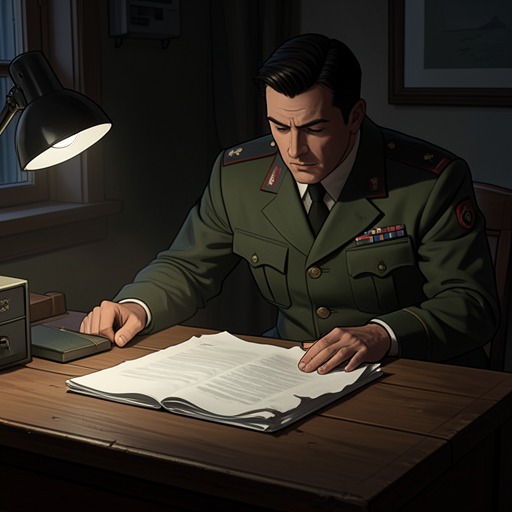
Picquart challenges Guénée’s testimony about Val Carlos
An Officer and a SpyPicquart’s challenge to Guénée turns a casual question about a secret file into a test of the evidence used against Alfred Dreyfus. By comparing Guénée’s hesitant answers with the deposition kept in the file, Picquart sees that the supposed warning from the Marquis de Val Carlos may never have been given at all—and that Major Henry’s courtroom accusation may rest on the same invention.
From a troubling file to a pointed question
The confrontation begins amid Picquart’s mounting concern about a pamphlet that may be published abroad. He has added Bernard Lazare’s name to a list that has reached twenty-one, and the uncertain prospects of publication leave him exasperated. Turning back to the secret file, he tells Guénée that it is becoming an embarrassment and asks whether Guénée helped compile it. The question is delivered casually, not as a formal interrogation; that apparent informality makes Guénée’s denial more revealing when Picquart follows it with a specific reminder.
Picquart asks whether Guénée supplied Major Henry with a statement from the Spanish military attaché, which had formed a central part of the case against Dreyfus. Guénée first denies involvement, then appears unsure, and finally concedes that he must have provided it because Henry says he did. His answers do not establish what happened; instead, their sequence gives Picquart reason to press the gap between Guénée’s present recollection and the testimony preserved in the file.
The deposition under examination
Picquart takes Henry’s deposition from his desk drawer and reads the alleged message attributed to Val Carlos. It warns of an officer on the General Staff who is keeping the German attachés informed, urges intensified surveillance at the Ministry of War, and tells Guénée to find the officer. The statement is not a vague recollection in this exchange: Picquart places its wording before Guénée and asks him to account for it. Guénée responds that it sounds about right.
The chronology gives the claim particular force. Asked whether Val Carlos made the statement roughly six months before Dreyfus was arrested, Guénée says it was in March. Yet Picquart remains unconvinced. The deposition, he thinks, sounds less like the speech of a Spanish marquis than the work of a policeman inventing evidence. The contrast is not simply between a document and a witness’s memory: it is between the authoritative form of an official statement and the suspicion that its polished account has been manufactured.
Picquart then makes the claim answerable to its supposed source. He asks Guénée to imagine asking the marquis directly whether he had said those words to Guénée, and whether the marquis would confirm that they helped send Dreyfus to Devil’s Island. Guénée’s face shows panic. He retreats from his earlier confidence, arguing that the conversation was confidential and that, amid the current press coverage, he cannot know what Val Carlos would say now. His evasion does not prove that the marquis never spoke, but it leaves the central assertion without the firm support Guénée had seemed to grant it.
From one disputed statement to Henry’s accusation
The decisive inference comes when Picquart connects the two versions of the supposed warning. If Val Carlos never gave the information to Guénée, Picquart reasons, then he did not give it to Henry either. The alleged conversation with Henry had supplied the basis for Henry’s theatrical testimony at Dreyfus’s court-martial, culminating in the declaration, “The traitor is that man!” The scene therefore shifts the question from whether Guénée can remember a statement to whether the prosecution’s dramatic identification of Dreyfus was built on a story with no reliable source.
The title of the episode names a challenge to testimony, but the scene’s pressure comes from the chain of repetition that testimony reveals. A purported warning passes from Val Carlos to Guénée, from Guénée into a deposition, and from an alleged conversation with Henry into a courtroom accusation. At each stage, the claim gains institutional weight; Picquart’s questions work backward through that chain, testing whether any dependable act of speech stands at its beginning. His suspicion that the words read like fabricated evidence makes the secret file itself a liability: material assembled to secure the case against Dreyfus may instead expose how that case was made.
Interruption and the limits of the scene
Picquart does not resolve the matter in this encounter. After the pause, Captain Lauth appears at the door to say that Boisdeffre wants Picquart to come over immediately. Picquart tells Guénée they will speak again, leaving the confrontation suspended just as the implications of Guénée’s uncertainty have become clear. The summons also returns the inquiry to the hierarchy surrounding the file: Picquart’s examination of a subordinate is interrupted by a call from a senior officer.
The episode is presented through Picquart’s first-person account, including his immediate thought that Guénée is still lying and his alarm at what the officers may have been doing. The author’s note frames the larger book as a novelistic retelling of the Dreyfus affair: its principal figures and most events are real in some form, but the narrative also simplifies, dramatizes, and invents personal details. It specifically says that Picquart never wrote the secret account imagined by the novel. The scene can therefore be read as the book’s dramatized construction of an investigative turning point, rather than treated as a verbatim historical transcript. Its significance lies in the logic it stages: a seemingly peripheral statement, once tested against its source and its later use, threatens to unsettle the accusation it helped sustain.